Virginia’s Path to Clean Energy: Key Legislative Insights

In recent years, progress on the clean energy transition has seesawed. Incredible progress was made in 2020 with passage of the Virginia Clean Economy Act (VCEA), a number of solar freedom bills, and joining the Regional Greenhouse Gas Initiative (RGGI). In 2021 the Virginia Clean Cars Act was signed. The Youngkin administration attempted to roll back much of that progress – taking Virginia out of RGGI, but ultimately failed to weaken or repeal the VCEA and Clean Car standards.

At a federal level, the Inflation Reduction Act (IRA) of 2022 was a landmark bill for clean energy. Many of its tax incentives for clean energy were repealed or reduced as part of 2025’s One Big Beautiful Bill Act (OBBA), making the clean energy transition slower and more costly.

Governor Spanberger begins her administration with an opportunity to build on the progress the Commonwealth of Virginia has made, while mitigating the loss of federal incentives. It also must contend with an exponential growth in demand for electricity for power data centers.

Meeting the electricity needs of the Commonwealth while maintaining its commitment to the VCEA will no doubt be a challenge. The JLARC study from 2024 says that just meeting half of the projected demand for data centers would be “difficult to achieve”.

Even without incentives, renewables like solar, wind, and storage are inexpensive and quick to deploy. Natural gas plants have become increasingly costly to build, risk becoming stranded assets, and rely on a fuel source that is subject to price volatility. Building conventional nuclear power plants is costly and typically takes longer than a decade. Promising clean energy technologies like nuclear small modular reactors (SMRs) and nuclear fusion are still about a decade off from viability at scale. For the next decade renewables are the clear first choice for meeting the Commonwealth’s rising electricity needs.

With all this in mind, the Virginia General Assembly should focus on legislation that:

  • Enables the rapid deployment of renewables such as solar, wind, and energy storage.
  • Thoughtfully manages the growth of electric demand from data centers.
  • Keeps Virginia on track to meet the goals of the VCEA. 
  • Rejoins Virginia to the RGGI.
  • Reduces costs to ratepayers.
  • Prepares Virginians to meet the challenges and reap the benefits of a clean energy transition.

For those reasons, Zero Carbon Virginia endorses the following bills, all of which are still alive at crossover:

Electric Demand

HB284 directs the State Corporation Commission (SCC) to establish electric demand flexibility programs for high demand customers, such as data centers, while SB43 calls for the Virginia Department of Energy to generate a report on demand response programs in the Commonwealth. These programs reduce peak power demand increases and reduce the need for additional capacity, distribution, and transmission infrastructure.

Data Centers

HB591 codifies the need for a data center strategy in the Energy Policy of the Commonwealth to  to support grid reliability, affordability, and the deployment of renewables.

HB897 ties clean energy standards to Virginia’s data center retail sales and use tax exemption. It would incentivize data centers to use clean energy for on-site generation and backup, purchase renewable energy credits, and invest in energy efficiency measures.

Rejoining RGGI

HB397 / SB802 affirms and strengthens the existing language directing DEQ to create and maintain an auction program consistent with the RGGI and the Clean Energy and Community Flood Preparedness Act. Participation in RGGI accelerates the transition toward renewable energy while generating funds for energy efficiency and flood preparedness.

Utility Regulation

HB429 / SB249 reforms the process of creating Integrated Resource Plans (IRPs), adding oversight from the SCC. IRP reform ensures that utilities are adequately planning to meet anticipated demand with clean, low-cost energy in compliance with the VCEA.

HB1065 directs utilities to identify grid interconnection points with unused capacity and use solar and storage to take advantage of that capacity. This efficiently uses existing infrastructure, reducing the need for new transmission and distribution. 

Solar Energy

Several bills this session enable creative solutions for deploying solar energy:

  • HB395 / SB250 permits utility customers to own and operate small portable solar generation devices (“balcony solar”).
  • HB1234 / SB26 enables localities to require solar canopies for non-residential parking areas with 100 spaces or more.
  • HB508 / SB340 adds the definition of agrivoltaics to the Virginia Code’s small renewable energy projects. Agrivoltatics are a way to synergistically integrate solar into certain farms.
  • HB590 / SB382 establishes the Smart Solar Permitting Platform to streamline the permitting process for residential solar and battery projects.

We hope that you’ll join us in supporting all of these bills in the hopes of re-establishing Virginia as a leader in the clean energy transition.

Zero Carbon Virginia Hosts Energy Transition Summit

Zero Carbon Virginia, a citizen’s group seeking a non-partisan path toward a zero-carbon energy future, hosted the Virginia Energy Transition Summit in Richmond, Virginia, on Saturday, August 24, 2019. The educational and informational event provided a group of Virginia General Assembly members and staff the chance to discuss the opportunities and challenges of the ongoing transition to cleaner energy resources that are developing across the United States.

Continue reading “Zero Carbon Virginia Hosts Energy Transition Summit”
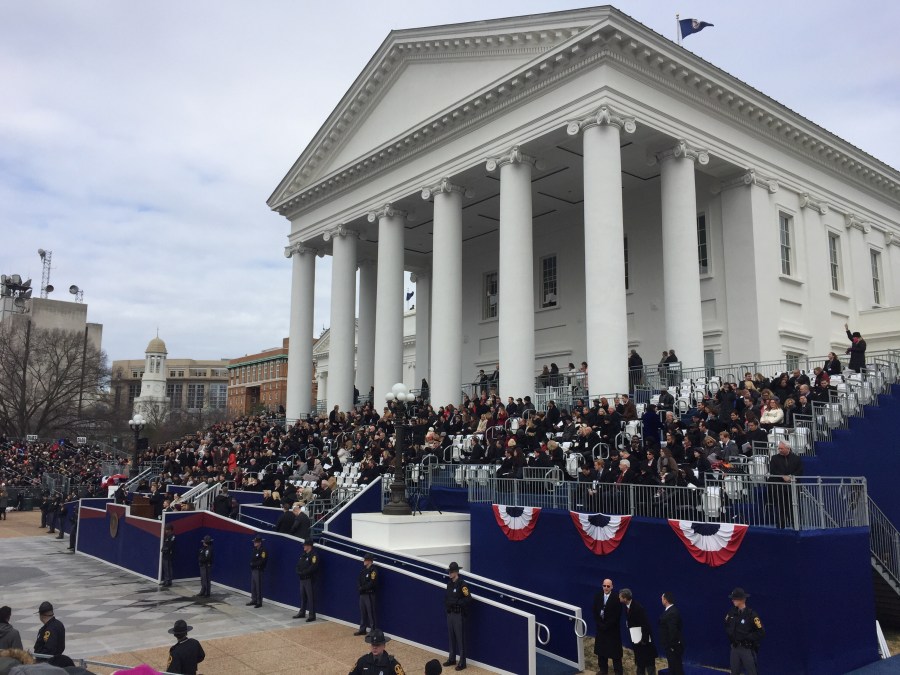
State Capitol of the Commonwealth of Virginia

Now, Are We Serious About Climate Change?

Climate news in 2019 is starting off where 2018 left off. Just this past week we learned that our oceans are warming faster than expected and that US carbon emissions rose 3.2% in 2018. This rise ends three years of declining emissions and is the largest increase since 2010. In November, the Black Friday Report  showed how the impacts of climate change are already being felt across the US, including in Virginia. And, in October, we learned that aggressive reductions in carbon emissions are our only chance to avoid catastrophic temperature rise.

There is no doubt, climate change is a serious issue. Yet, as scientists sound these alarms, we are busy debating a border wall, who should run for president in 2020, troop withdrawals from Syria, and how much the Russians are influencing our elections. It is as if we are driving along a challenging roadway but cannot take our eyes off our mobile phones long enough to see the cliff that we are about to drive over.

Continue reading “Now, Are We Serious About Climate Change?”

Governor Terry McAuliffe’s Actions on Climate Change

During his time in office, Governor Terry McAuliffe led action on climate change through a number of executive actions. These actions took steps to move Virginia forward and provide a road map for near-term to bring cleaner energy and economic growth to Virginia. Some of Governor McAuliffe’s actions are summarized below.

Continue reading “Governor Terry McAuliffe’s Actions on Climate Change”

Support the Renewables First Act

The majority of Virginia’s electricity is based on burning fossil fuels, mainly natural gas and coal. The effects of the resulting climate change are all around us. For example, the six hottest years recorded have occurred over the last decade. Tens of millions of dollars are spent annually to harden Virginia’s coastal military bases against sea level rise. Science tells us that we must hold global temperature increases under 2°C (3.6°F), or suffer staggering economic and social upheaval. To realize this goal, the major economies must pursue ‘deep decarbonization’, reducing carbon emissions by approximately 80% by mid-century.

In addition to producing heat-trapping gases, the burning of fossil fuels produces particulates and gases, which cause toxic ground level ozone. This is a big problem in many parts of the developed and developing world, including Virginia (The American Lung Association gives out letter grades for air quality; Loudoun County’s air gets a ‘C’, Fairfax’s an ‘F’). Public health provides a second strong incentive to reduce fossil fuel-based energy production. We all have to do our part in reducing fossil fuel emissions, including Virginia. Delay is not an option.

Continue reading “Support the Renewables First Act”

Virginia Energy Plan Public Comments: A First Look

Word Art

The Virginia Energy Plan is currently being updated as required under Virginia Code § 67-201. The plan is updated every four years and covers a ten year period. The Department of Mines, Minerals and Energy (DMME) is leading the effort and has hosted a number of public input sessions and accepted written comments through Virginia Regulatory Town Hall online forum. Online, public commenting closed at 11:59 PM on Friday August 24.

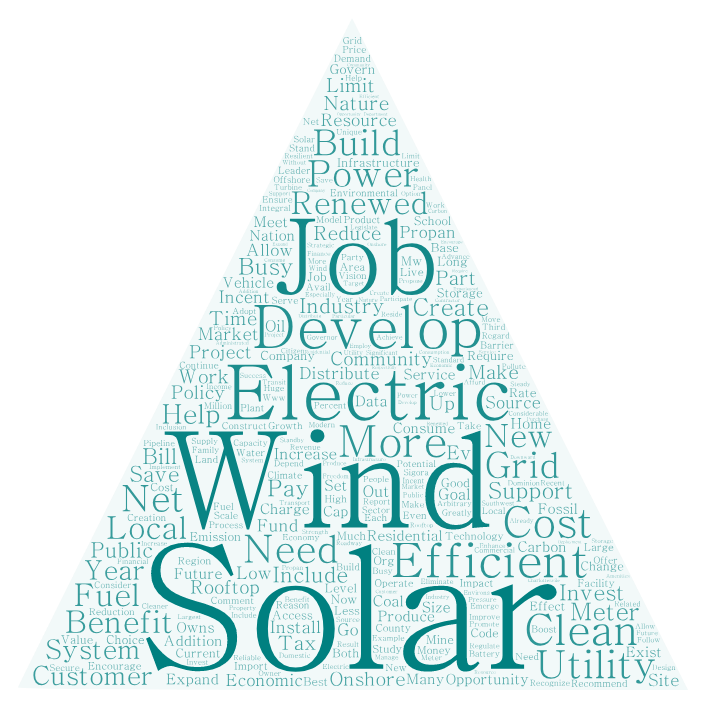
A first look at what the public has to say reveals a strong push to move Virginia forward into a new, clean energy economy. A total of 697 comments are posted on Virginia Regulatory Town Hall online forum. We identify 662 unique posters (individuals, organizations, or businesses).  We also identify 145 organizations that are represented by comments made on the forum.

Continue reading “Virginia Energy Plan Public Comments: A First Look”

A Path to Zero Carbon: Comments on the Virginia Energy Plan

The Virginia Energy Plan is currently being updated as required under Virginia Code § 67-201. The plan is updated every four years and covers a ten year period. The Department of Mines, Minerals and Energy is leading the effort and has hosted a number of public input sessions. They also are accepting written comments through Virginia Regulatory Town Hall online forum. Below are the comments made by Zero Carbon’s Dr. Harrison Crecraft at the August 16 public input session at George Mason University.

We have all heard the alarms about greenhouse gases (GHGs) and global warming. I would like to start by offering a bit of geologic perspective. Since the start of the industrial period, CO2 has soared from 290 to 410 ppm. Its timing and isotopic signature leave no question that this spike in CO2 is from burning fossil fuels. At current rates, CO2 will reach 500 ppm within 45 years.

The last time CO2 was at today’s levels was 3 million years ago. Geologically speaking, this is the recent past. At that time, according to a 2017 Yale University report, global temperatures were 4-5°F warmer; the arctic was 20° warmer; and sea levels were at least 60 feet higher. Although the precise response of elevated GHGs on climate is complex and the details are debated, there is no debate about the basic science: elevated heat-trapping gases requires higher global temperatures in order to balance the solar energy input.

Continue reading “A Path to Zero Carbon: Comments on the Virginia Energy Plan”

Planning for Zero Carbon 2050

The Virginia Energy Plan is currently being updated as required under Virginia Code § 67-201. The plan is updated every four years and covers a ten year period. The Department of Mines, Minerals and Energy is leading the effort and has hosted a number of public input sessions. They also are accepting written comments through Virginia Regulatory Town Hall online forum. Below is an expanded version of comments made by Zero Carbon’s Scott Emery at the August 16 public input session at George Mason University.

Over the decades, Virginia built its electric power industry following the common path of building big, centralized production facilities and expanding the electric power grid to make affordable electricity accessible to all. Abundant, energy-dense fossil fuels power most of our generation, and  have significantly shaped how our electric power industry operates. In many ways, this has been good for Virginia, but it is time for a change.

Continue reading “Planning for Zero Carbon 2050”

Statement on Proposed Energy Legislation – HB 1558

Zero Carbon Virginia is a group of Virginian scientists, engineers, economists and public health experts who seek to guide our state toward practical, cost-effective, sustainable, healthy, and therefore ultimately carbon- free, energy production and distribution technologies. Driven by the urgency to address public health, climate change and the economic and quality-of-life opportunities that are enabled by advanced technologies, we seek long-term solutions, in collaboration with legislators and other groups, that will allow Virginia to lead in low cost, clean energy production.

We applaud the efforts of all who are working to move Virginia’s energy infrastructure and economy forward. HB 1558 represents an ambitious plan to shape Virginia’s energy future. Such a consequential plan must be deliberated, must be clear and transparent, and must serve the interests of all Virginians. Currently this bill does not meet these criteria.

Continue reading “Statement on Proposed Energy Legislation – HB 1558”

A Time for Bold Action in Richmond

Virginia’s 2018 legislative session begins on January 10. On January 7, I spoke at the Loudoun delegation’s legislative hearing in Leesburg, Virginia. Here is what I said.

President Obama said, “The climate is changing faster than our efforts to address it… and if we do not get this issue right, every other issue we deal with will be adversely affected.” Taking action on climate change is a moral imperative.

Continue reading “A Time for Bold Action in Richmond”